FAQ
Frequently Asked Questions about TierHub
Below are answers to frequently asked questions about TierHub – covering what it is, how it works, and how it benefits various stakeholders. (For more detailed inquiries or a personalized consultation, please Book a Demo with our team!)
Q: What is TierHub?
A: TierHub is a blockchain-based traceability platform for the seafood supply chain. It serves as a digital record-keeping and verification system that tracks seafood products from their point of harvest (catch or farm) all the way to the consumer’s plate. By logging each step on an immutable blockchain ledger, TierHub provides a single source of truth about where the seafood came from, how it was processed, and its journey through the supply chain. In short, TierHub is a tool to build trust by ensuring transparency and authenticity in every seafood transaction.
Q: How does TierHub work?
A: TierHub works by assigning each batch or item of seafood a unique digital identity (often via a QR code or NFC smart tag) that travels with it. At every step – catch, landing, processing, shipping, and sale – stakeholders scan or update that digital record through the TierHub app or interface. Key data (such as species, weight, location caught, time, vessel or farm ID, storage temperature, etc.) are recorded on the blockchain in real time.
This creates an unbroken chain of information that is tamper-proof and easily accessible. If you’re a consumer, you can scan the final QR code on the package to see the entire history of that fish (where it was caught, by whom, when, how it was handled) presented in an easy-to-understand story format. If you’re a business, TierHub provides dashboards and analytics to track products and ensure compliance. Everything is backed by immutable blockchain records and AI verification to ensure the data is reliable and flags any irregularities.
Q: Who is TierHub for?
A: TierHub is designed for all stakeholders in the seafood supply chain – this includes:
- Producers: fishermen, fishing companies, and aquaculture (fish farm) operators who harvest seafood.
- Processors and Distributors: companies that handle seafood after catch (processing plants, exporters, importers, wholesalers, logistics providers).
- Retailers and Food Service: supermarkets, fish markets, restaurants – anyone selling seafood to consumers.
- End Consumers: everyday shoppers and diners who want to know where their seafood comes from.
- Regulators and Certification Bodies: authorities or auditors who need to verify that seafood products meet certain legal or sustainability standards.
TierHub provides tailored benefits to each group – from helping fishers prove their catch is legal and sustainably sourced, to aiding distributors in inventory tracking and compliance, to empowering consumers to make informed choices about what they eat. It’s a holistic platform where each participant can access the information relevant to them, all from the same trusted dataset.
Q: What makes TierHub different from other traceability solutions?
A: TierHub’s key differentiators are its use of advanced technology and its focus on end-to-end engagement. Firstly, TierHub leverages blockchain for data integrity and AI & IoT for data collection and validation. This means the platform not only records data, but actively checks and enriches it – e.g. IoT sensors upload temperature and humidity or location data automatically, and AI algorithms flag any anomalies (like a journey that took too long, or data that doesn’t match expected patterns). Many traditional traceability systems are manual or paper-based; TierHub is digital, automated, and tamper-proof by design.
Secondly, TierHub is more than a compliance tool – it’s built to drive trust and value. It has a consumer-facing side (the ability for shoppers to scan and see the product’s story), which not all traceability solutions offer. TierHub also acts as a marketing platform for suppliers: by showcasing verified stories of quality and sustainability, businesses can strengthen their brand and reach new customers. In short, TierHub combines supply chain rigor with storytelling and engagement, whereas many competitors focus only on internal tracking. Our motto “Trust in Every Relationship” underscores that we facilitate transparency not just as data, but as a narrative that connects producers and consumers.
Q: Why is TierHub focused only on seafood? Can it be used for other products?
A: We chose to focus on the seafood industry initially because it has some of the most urgent and complex traceability needs – issues like illegal fishing, mislabeling, and sustainability are especially pronounced in seafood. By specializing in seafood, TierHub can offer features and data tailored to fish and shellfish supply chains (for example, integration with fishing vessel tracking systems, support for fisheries certifications, monitoring of cold-chain for perishability, etc.). This laser focus allows us to deeply understand the industry’s pain points and solve them effectively. In the future, TierHub’s technology could potentially extend to other food or commodity supply chains, but our current mission is to revolutionize seafood traceability. By keeping our scope targeted at this startup stage, we avoid confusion and ensure we deliver the best possible solution for seafood stakeholders. (In short: yes, the core technology could work for other products, but we believe doing one domain exceptionally well is better than doing many poorly. So, seafood it is – for now!)
Q: What technologies does TierHub use?
A: TierHub is built on a stack of modern technologies aimed at trust and scalability:
- Blockchain / Distributed Ledger Technology (DLT) – to create immutable, tamper-proof records of each transaction or data entry. This provides the security and trust layer (once data is recorded, it can’t be altered secretly).
- AI / Machine Learning – to analyze the data for inconsistencies, predict supply chain needs, and automate verifications. For example, AI might detect if a shipment’s travel time was abnormally long (indicating a delay that could affect freshness) or if a supplier’s data has irregular patterns, prompting further review.
- IoT Sensors & Smart Tags – devices like GPS trackers, temperature sensors, RFID/QR codes, and NFC tags are used to capture data automatically from the physical world. A fishing vessel might have a sensor that logs the location and time each fish is caught; a refrigerated truck might monitor temperature; each of these data points flows into TierHub’s system.
- Cloud & API Integrations – TierHub is a cloud-based platform, which means it’s accessible from anywhere and can scale as needed. We provide APIs to integrate with existing systems (like a company’s ERP or inventory software) so that TierHub can slot into current workflows without hassle. This also means if you already use a system to, say, record your catches or manage warehouse stock, TierHub can connect to it and exchange data.
All these technologies work in concert to ensure that the data in TierHub is real-time, accurate, and secure. Importantly, you do not need to be a tech expert to use TierHub – the complexity runs under the hood. Users interact through a simple app and web dashboard, while these technologies ensure the trustworthiness of the information.
Q: Is TierHub a cryptocurrency or does it use tokens like some blockchain projects
A: No, TierHub is not a cryptocurrency and does not involve any public tokens or crypto-trading. It uses blockchain technology purely as a backend tool to secure data and ensure traceability. Some other initiatives have introduced tokens to incentivize data sharing, but TierHub takes a different approach. We believe stakeholders are naturally incentivized by the market benefits of transparency – such as meeting regulatory requirements, accessing new markets, and building consumer trust (which can translate to higher sales). TierHub’s platform provides value to participants (e.g. access to the marketplace of conscious consumers, proofs for compliance, etc.), which encourages them to share accurate data without the need for a crypto token reward. In essence, TierHub’s “currency” is trust – by contributing data, honest suppliers gain credibility and potentially market advantage. There’s no need to purchase any cryptocurrency to use TierHub; all transactions on our blockchain are behind-the-scenes and handled by the system.
Q: How does TierHub ensure the data entered is accurate and not falsified?
A: This is a great question, because any traceability system is only as good as the data fed into it. TierHub tackles this in several ways:
- Immutable Records: Once data is entered and confirmed on the blockchain, it cannot be retroactively changed. So, if someone tried to alter a harvest date or swap the species name after the fact, the system would show that an attempt to change history occurred (which is a red flag in itself).
- Multi-point Verification: Data is often corroborated by multiple parties. For example, a fisher records a catch, and later a processor confirms receipt of that same batch – the quantities and timestamps should align. If they don’t, TierHub will detect the discrepancy.
- AI Anomaly Detection: TierHub’s AI analyzes patterns and can spot anomalies that might indicate false data. For instance, if a supplier suddenly reports an unrealistic volume of catch (far above their normal capacity), or if a “cold chain” record shows a perfectly constant temperature (which might suggest manual input rather than sensor data), the system will flag it for review.
- IoT and Automation: Wherever possible, TierHub relies on automatic data capture (scans, IoT sensors, GPS, digital timestamps) rather than manual input, to reduce human error or tampering. For example, when a truck carrying seafood arrives at a facility, a GPS geotag and time can automatically log that event, rather than relying on someone’s report.
- User Reputation and Audit Trails: Every action on TierHub is linked to a user or entity account. Over time, suppliers build a history. Consistent, reliable reporting builds a good reputation, whereas any incidents of false reporting (which are visible) would damage a supplier’s credibility on the platform. Because data is transparent to relevant stakeholders, there’s a strong disincentive to cheating – it would likely be caught, and the consequences include loss of trust or business. TierHub also allows for audits; third-party auditors or certification bodies can be given access to verify data directly on the platform.
In combination, these measures mean TierHub greatly reduces the opportunity and incentive for false data. While no system can guarantee 100% perfection, TierHub is a significant improvement over paper logs or siloed databases, where tampering and fraud historically went undetected. Our goal is to make the data as truthful and self-validating as possible.
Q: Will my sensitive business data (like exact fishing spots or supplier lists) be visible to everyone on the blockchain?
A: No, TierHub respects confidentiality and uses a permissioned approach to data sharing. While the platform is built on blockchain, it doesn’t mean all data is public to the whole world. We understand businesses have competitive secrets. TierHub allows granular access control – meaning certain data can be made visible only to authorized parties. For example, a consumer scanning a product might see “Caught in San Remo, Victoria” rather than the precise GPS coordinates of the catch if the supplier prefers to generalize that information.
Similarly, detailed supply chain data might be accessible to a regulator or a buyer you are working with, but not necessarily to a competitor. We often use a permissioned blockchain model, where all participants are known entities, and data can be encrypted on-chain such that only those with the right keys (permissions) can view certain details. At the same time, the fact that an event happened (and its validation hash) is recorded immutably, so the integrity is maintained without exposing all details. In summary, TierHub balances transparency with privacy: consumers and partners get the information they need for trust, while businesses can protect sensitive specifics as needed.
Q: How can TierHub help with regulatory compliance?
A: TierHub is very much aligned with emerging seafood regulations. For instance, the U.S. Seafood Import Monitoring Program (SIMP) requires key data elements and traceability for certain species imports, and the EU’s proposed Digital Product Passport will mandate detailed supply chain records for food products. TierHub can serve as a ready-made compliance system: it naturally collects all the required information (origin, species, dates, processing steps, etc.) and keeps them in a secure format.
Instead of scrambling to compile paperwork for an audit or export, a company using TierHub can instantly generate reports or grant inspectors access to the digital records proving compliance. Because the data is authenticated (thanks to blockchain), it adds an extra layer of credibility. In short, TierHub helps businesses meet legal requirements with less hassle – whether it’s traceability mandates, sustainability reporting, or food safety record-keeping. By using TierHub, companies are effectively staying ahead of the curve, as global regulators move toward demanding end-to-end traceability.
Q: Does TierHub support sustainability certifications (like MSC, ASC) or other standards?
A: Yes. TierHub is designed to complement and incorporate existing certifications and standards. Rather than replacing certifications, we amplify them. For example, if a fishery is certified by the Marine Stewardship Council (MSC) or Aquaculture Stewardship Council (ASC), that information can be recorded in TierHub and linked to the products from that fishery. When a consumer scans the product, they might see the MSC certification logo and details as part of the product’s story.
Additionally, TierHub can record data required by certification schemes (like sustainable catch method, no IUU fishing, etc.) to provide continuous proof that practices remain in line with standards. We also follow data standards like GS1 EPCIS for product traceability events, which means TierHub’s data can be interoperable with other systems and supply chain partners. Essentially, TierHub acts as a digital proof layer for sustainability claims – providing trust but also granularity (exact dates, locations, methods) behind a certification’s broad assurances.
Q: Is there a consumer app? How do end-users use TierHub?
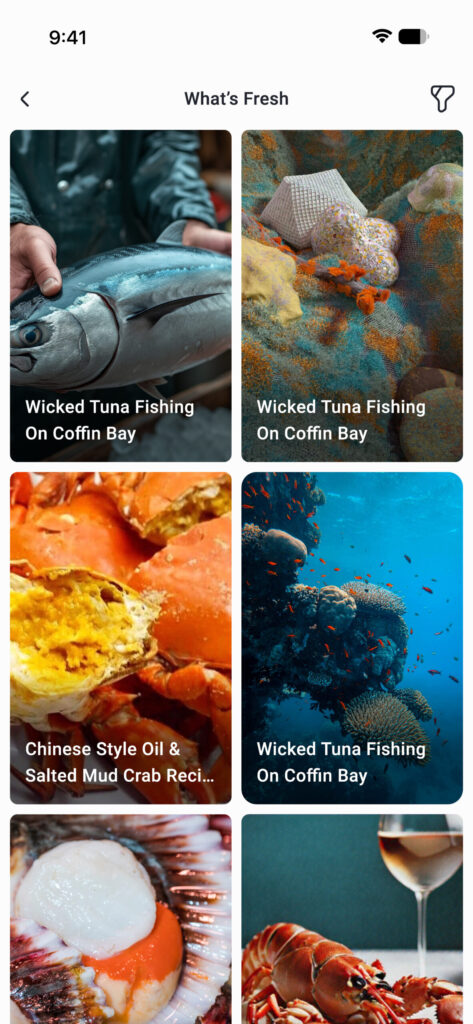
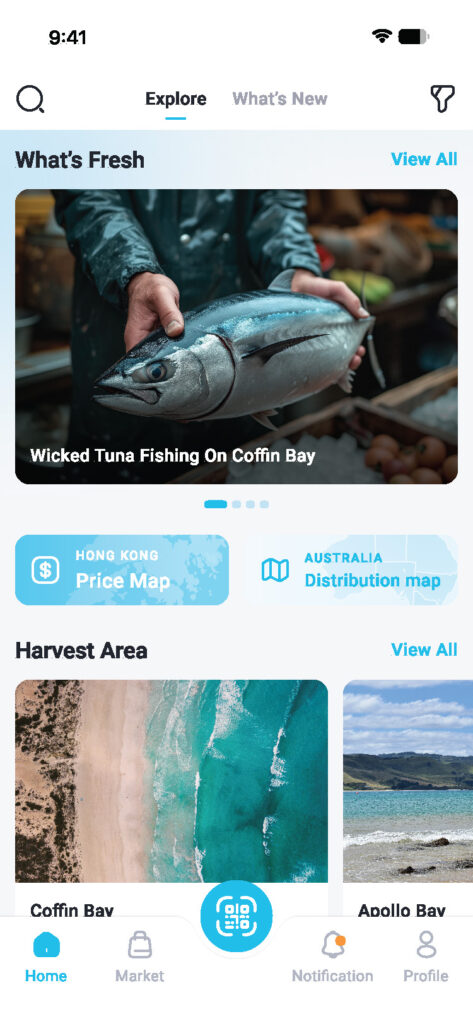
A: Yes, TierHub provides a user-friendly mobile app (as well as a web portal) for end consumers. If you’re a seafood consumer, using TierHub is as simple as scanning a QR code on the product package or at a restaurant menu with your smartphone. You don’t even need to log in – scanning will automatically pull up a rich “story page” for that seafood item. On that page, you might see: the species name and photo, a map showing where it was caught or farmed, the name or boat of the fisher (if provided), the date it was caught, how it was processed (e.g. frozen at sea or processed at a certain facility), and any sustainability info (certifications, if it was caught in-season, bycatch mitigation efforts, etc.). It’s a bit like “Farm-to-table” but for seafood – from sea to plate, you get to see it all.
The experience is designed to be engaging and informative, often with high-quality imagery of the harvest location or species, so you can truly connect with the source. Consumers can also use the TierHub app to provide feedback or learn cooking tips about that species, etc., although the core function is traceability info. From the app perspective, scanning is free and open to anyone. If you want to go further, you can create an account to, say, follow certain producers or get notified when your favorite sustainable seafood is back in season. We are also integrating a feature for consumers to share the story on social media – turning traceability into a conversation starter. The goal is to make the transparent choice the easy and rewarding choice for consumers, thereby encouraging more people to care about sustainability. As one fishing captain described the value of this transparency: “People can just scan the barcode and the whole story is right there in front of them.” TierHub enables exactly that kind of experience for consumers everywhere.
Q: How do producers or businesses get started with TierHub?
A: For seafood businesses (be it a fishing company, processor, brand, etc.), getting started with TierHub typically begins with a conversation – we invite you to Book a Demo through our website. During the demo or consultation, we assess your current process and show how TierHub can fit in. On a practical level, onboarding involves:
- Setting up a TierHub account for your business and defining your role in the supply chain (e.g., harvester, distributor, retailer, etc.).
- Receiving or generating the digital tags (QR codes/NFC) for your products. If you already have barcode or QR systems, we can often integrate with those or co-label.
- Training or integration: We provide training for your team on using the TierHub mobile app or web dashboard to log events. If you prefer automated integration, our tech team can integrate TierHub with your existing software so data flows automatically (for example, linking your electronic catch reporting system or warehouse management system with TierHub via API).
- Going live: Once set up, you can start logging real production batches in TierHub. You might tag fish or containers with TierHub codes, and then at each handoff, scan and update the status. We often start with a pilot project – for instance, trace one product line or one fishing trip end-to-end – and then scale up usage from there.
For smaller producers who may not have existing systems, TierHub’s app is designed to be simple and standalone, so even a single boat owner with a smartphone can record their catch into TierHub in a few taps (enter species, weight, location – or let a connected GPS fill location – and you’re done!). We also offer support and guides during onboarding. Our aim is to make traceability as easy as possible so it’s not a burden but a benefit.
Q: Does using TierHub require special hardware or devices?
A: Not necessarily. If you have a smartphone or computer, you can use TierHub. The QR code labels can be printed on ordinary printers, and the scanning can be done with any smartphone camera (within our app or even a generic QR scanner that then points to our web link). That said, TierHub can take advantage of special hardware if available. For example, if you want to use NFC tags on high-value products, you would need NFC stickers and phones that can read them.
Or if you want to use IoT sensors (say, a temperature logger in a shipping container), that sensor device is additional hardware – but it’s optional. TierHub is flexible: it works with just simple QR codes and phones for most cases, but it can integrate with more sophisticated setups if a user has them. We have some partners who use rugged handheld scanners in factories – those can work with TierHub as well via our app or API. Fundamentally, we didn’t want expensive hardware to be a barrier, so the core system just needs internet access and a device capable of a scan or data entry. Many fishers just carry an inexpensive smartphone in a waterproof case and that’s sufficient to use TierHub on the boat.
Q: Is TierHub accessible globally?
A: Yes, TierHub is a cloud-based platform and is accessible anywhere you have an internet connection. Our initial operations are in Australia (where we are based) and the Asia-Pacific region, but the platform is built to be global. We already support multiple languages for data entry and are onboarding clients in other continents as well. Because compliance needs don’t stop at borders – seafood is a highly international trade – TierHub is designed to connect across countries.
Whether a fish is caught in New Zealand and sold in the US, or farmed in Vietnam and shipped to Europe, TierHub can trace it. We are also mindful of different regional standards (for instance, EU, US, and Asia traceability regulations) and configure the data capture accordingly. If you have operations in remote areas, TierHub’s mobile app has an offline mode as well – it can cache data when you’re out of signal range (say, on a boat offshore) and then sync up when back in range. In summary, no matter where you are located, you can join the TierHub network. Our support team is also global, to assist users in various time zones.
Q: How much does TierHub cost?
A: TierHub offers a range of plans tailored to different user needs. For basic use (for example, a small-scale fisher or a single restaurant who just wants to provide traceability info), we have a free tier that allows a limited number of traceability records per month, which is often sufficient to get started. For larger businesses, we charge a subscription or SaaS fee based on usage volume and features required. Our pricing is designed to be affordable and to scale with your operation – for instance, a seafood exporter might pay a monthly fee that covers X number of shipments traced, along with analytics and support services. We don’t take a cut of your sales; our model is subscription, not transaction percentage.
We also offer enterprise plans for big companies needing custom integration, which is a negotiated rate. The best way to get an exact quote is to contact us for a demo so we can understand your scope. But rest assured, cost should not be a barrier – we are keen on working with even small community fisheries or startups. In fact, part of our mission is to empower small producers (who often can’t afford expensive software) to access markets by providing traceability, so we strive to keep TierHub cost-effective. (Note: The specifics may evolve as we grow, but our commitment is to deliver clear ROI – our clients often find that the value gained from better market access and efficiency far outweighs the subscription cost.)
Q: Can TierHub integrate with our existing systems (ERP, inventory management, etc.)?
A: Yes, TierHub is built with integration in mind. We provide APIs (Application Programming Interfaces) and support standard data formats (like JSON/CSV, and GS1 EPCIS events for traceability) so that we can connect with many existing enterprise systems. For example, if you already use an ERP system to manage lots, or a logistics software to scan barcodes in your warehouse, TierHub can likely plug into those processes. This way, your staff don’t have to do double data entry.
In many cases, we can set up automatic data feeds – e.g., when you enter a production batch in your system, it pings TierHub’s API to create the traceability record simultaneously. We also integrate with hardware: if you have IoT sensors, or even something like a digital scale that outputs data, that can feed into TierHub. Our team will work with you during onboarding to identify integration points. We understand that businesses have existing investments in IT, so we aim to add value, not disrupt. And if you don’t have any complex systems in place, TierHub’s app/dashboard can function as a standalone system for your traceability needs.
Q: What benefits does TierHub offer to seafood producers (fishers or fish farmers)?
- Proof of Legitimacy and Quality: It provides a credible proof of where and how your seafood was caught or raised. This is increasingly required to sell in certain markets, and it can set you apart as a trusted source. If you operate responsibly, TierHub helps you prove it, which can elevate your product’s value.
- Market Access and Premiums: With traceability and sustainability data, you may access new buyers (e.g., eco-conscious brands or export markets with strict rules). Consumers have shown willingness to pay more for transparent and sustainable products[2], so your catch could fetch better prices if it’s verified. We’ve seen cases where traceable, certified products gain premium pricing because buyers trust them.
- Simplified Record-Keeping: Instead of maintaining paper logs for each catch or filling out numerous forms for regulators, you enter data once into TierHub and reuse it. The system can generate reports for you when needed. This reduces administrative burden and errors.
- Fairness and Recognition: TierHub’s “Ensure Fair Payments” ethos means we care that producers get their due. By tracking the supply chain, there’s transparency in transactions which can prevent unfair underpricing. For example, if a high-quality tuna is traced and tagged to you, downstream buyers can’t easily mix it with lower quality fish without it being noticed – so you’re more likely to be rewarded for quality. Also, your brand/story as a fisher can become known to end consumers, which is a source of pride and potentially loyalty (some consumers might start seeking out products from your boat or cooperative if they see consistent quality).
- Sustainability and Resource Management: Through TierHub’s data, fishers can also get insights – for instance, seeing which fishing grounds or practices yield the best outcomes or how timing affects quality. Over time, this can help optimize sustainable yields. Additionally, cooperating with traceability shows regulators and the public that you’re a proactive steward of the resource, which can be beneficial for policy support and community trust.
Q: What benefits does TierHub offer to distributors and processors?
- Inventory & Supply Chain Visibility: TierHub acts like a real-time tracking system for your products. You can see exactly which batch is where, its condition, and its history. This can improve inventory management (becomes easier to enforce when you can trace dates of harvest and processing). It can also help quickly pinpoint issues – if there’s a recall or quality issue, you can trace affected batches in seconds by filtering the data, instead of sifting through paperwork.
- Efficiency & Cost Reduction: By streamlining data exchange between partners (through our platform/API), TierHub reduces manual checks and errors. For instance, if you’re an exporter, instead of emailing documents to your importer, you both might share access to TierHub records for a shipment. This not only saves time but can reduce port delays, etc. Our AI analytics might also highlight inefficiencies (like a route where frequent delays occur, or product losses happening at a certain transfer point), so you can address them and cut costs.
- Trust and Client Satisfaction: Having TierHub can be a selling point to your clients (retailers or restaurants). You can provide them and their auditors with direct access to traceability info, which builds confidence. It shows that you as a distributor have done due diligence on your sourcing. In some cases, being able to verify sustainability or legal sourcing can allow you to secure contracts with large buyers who insist on traceability.
- Compliance Made Easier: If you’re dealing with multiple regulatory regimes (FDA/NOAA, EU regulations, etc.), TierHub consolidates the needed info. Instead of maintaining separate compliance logs, one TierHub record can serve multiple reporting needs. And because it’s blockchain-logged, authorities may trust it more readily. Early adopters of blockchain traceability in food have found that it can drastically cut down the time needed to trace items (from days to seconds), which is a huge advantage in a crisis management situation (like a contamination scare).
- Value-Added Services: As a forward-looking distributor, you could use TierHub data to offer more to your customers (retailers). For example, you might provide a portal where your retail clients can see the incoming supply chain of their seafood in real time. This kind of transparency can strengthen partnerships. Also, by being part of a traceability network, you future-proof your business against the increasing requirements of the market and regulators.
Q: How does TierHub benefit retailers, restaurants, and consumers?
A: For the retailers and restaurants, TierHub is a way to build brand trust and enhance customer experience: they can confidently make claims about their seafood (“sustainably caught”, “traceable back to a family fishery” etc.) and actually back those claims up by pointing to TierHub-powered info. Some restaurants might even present a QR code next to a seafood menu item so diners can see the story while they eat, turning dining into an educational experience. This kind of engagement can increase customer loyalty and differentiate the business in a crowded market. It’s also a safeguard: if you’re a retailer, traceability reduces the risk of unknowingly selling fraudulent or illegal products – protecting your brand from scandal.
For consumers, as mentioned earlier, TierHub offers peace of mind and enriched knowledge. You can avoid seafood that’s of dubious origin or linked to unethical practices, and favor products that are transparent. In an age of conscious consumerism, many people want to ensure their money supports sustainable and fair practices. TierHub empowers those consumers by giving them credible information at their fingertips. And beyond the serious side, it’s often just fascinating – you can see a picture of the actual boat that caught your fish or learn about the region it came from. It creates a connection between you and the source, making the meal more meaningful. Consumers can also trust that with TierHub, if there were any safety issues, the product would be traceable for recall – so it’s an extra layer of food safety assurance.
Q: What kind of stories or projects has TierHub done so far?
A: While TierHub is still in its early stages, we have already delivered several successful traceability projects and pilots. One notable example involved partnering with a local wild-catch fishery in Australia to trace hand-harvested abalone from a cooperative of divers through to a reputable distributor and retailer in Hong Kong and mainland China. Each harvest lot was tagged at the point of catch with a TierHub Source QR code, which was then scanned at every key stage — the landing site, the processing facility (where the abalone was graded, cut, and canned), during freight, and at the retailer’s receiving dock.
When the abalone was later promoted in-store, customers could scan the QR code to view the product’s entire journey — including a profile of the diver and sustainability notes about the fishery. The retailer reported that customers were delighted by this level of transparency, which strengthened their confidence in the product’s quality. The divers, in turn, valued the recognition of their work and the opportunity to see where their catch ultimately ended up. We have seen similar results in aquaculture, such as tracing a batch of oysters from a sustainable farm to retail outlets, with full water quality and feed information logged to demonstrate assurance of quality. These pilots highlight TierHub’s real-world impact: greater trust, increased willingness among customers to pay a premium, and stronger partnerships across the supply chain. (Detailed case studies will be published on our blog soon — stay tuned!)
Q: How does TierHub handle recalls or quality issues?
A: In the unfortunate event of a quality problem or contamination issue, TierHub greatly streamlines trace-back and recall procedures. Because every batch is uniquely identified and tracked, if a problem is discovered (say a certain lot tested positive for a contaminant, or there’s an illness outbreak traced to a product), you can quickly isolate the affected batch in TierHub. Our system can show exactly which shipments contained that batch, which suppliers it came through, and which end customers received it. This means a recall can be surgical and swift: you don’t have to pull every product off the shelves, only the ones linked to the issue, and you can do it faster – potentially preventing harm.
For example, what might take days of combing through paper records can be done with a quick search and verification on TierHub (there have been instances in the food industry where blockchain traceability cut recall tracing from days to mere seconds). Moreover, TierHub can notify downstream partners immediately if an issue is logged (everyone with that batch in their chain could get an alert). This kind of rapid response not only protects consumers but also minimizes the financial and reputational damage of a recall by containing it effectively. It’s essentially an insurance mechanism – you hope to never need it, but if you do, TierHub is your best tool.
Q: Where can I find the TierHub app?
A: The TierHub app will be available on both the Google Play Store for Android and the Apple App Store for iOS. As we launch publicly, we’ll provide direct links on our website (look for the “Download on App Store” and “Get it on Google Play” badges). The app is free to download. If you are a consumer, you can use it in guest mode to scan and view product info. If you are a business user, you can log in to access additional features for data entry and dashboard viewing. We also have a web application (accessible via any browser) for business users who prefer a desktop interface – the Web Dashboard is often convenient for managers to review analytics or for staff to bulk-upload data from a computer. We ensure that all platforms sync with each other in real time, so whether you log something on the mobile app or via the web portal, it’s all updating the single source of truth on the TierHub cloud.
Q: How does TierHub protect my data and system from unauthorized access or hacking?
A: Security is a top priority for TierHub. We implement multiple layers of protection:
- Blockchain Security: The core traceability ledger is on a blockchain network, which inherently means data entries are cryptographically linked. Without the proper cryptographic keys, no one can alter those records. This prevents data tampering.
- Cloud Security: Our platform runs on secure cloud infrastructure with encryption in transit and at rest. All connections to TierHub (from apps or browsers) are encrypted via HTTPS. Sensitive information is additionally encrypted in our databases. We also maintain regular backups and redundancy to prevent data loss.
- Access Control: Every user has authenticated access. We support strong authentication (and can enable two-factor authentication for enterprise accounts). Permissions are role-based – meaning a fisherman can only see and edit their own data, an exporter only sees data relevant to shipments they handle, etc. If a company invites multiple users, they can control what each user can do (view-only, edit, admin rights, etc.).
- Network Monitoring and Audits: We employ firewalls and monitor for any unusual activity on our systems. Regular security audits (including third-party penetration testing) are conducted to ensure there are no vulnerabilities.
- Smart Contract Audits: If applicable, any blockchain smart contracts we use (for example, automated logic for verifying data) are audited for security, to avoid exploits.
- Compliance: We comply with data protection regulations (like GDPR for personal data, etc.) to ensure user data is handled responsibly. Users have control over their data-sharing settings as mentioned.
In essence, we treat data security with the same seriousness as financial institutions treat banking data. Our goal is that users can trust TierHub not only for the truthfulness of data but also for its safety. To date, we’ve had zero security breaches and we intend to keep it that way through rigorous best practices.
Q: How can I join or partner with TierHub?
A: We are excited to collaborate with everyone in the seafood community who cares about traceability and sustainability! If you’re a seafood business (of any size) interested in using TierHub, the best step is to reach out via our Contact Us page or Book a Demo form. Our team will respond promptly to discuss your needs and show you the platform.
If you’re an industry organization, NGO, or government body working on seafood transparency initiatives, we’d also love to partner – whether it’s data sharing, standards development, or pilot programs to uplift certain fisheries. TierHub’s mission is very much aligned with broader industry improvement, so we welcome partnerships. We also have a newsletter and industry blog – you can Join Us by subscribing to stay updated on our progress and insights (just enter your email at the bottom of our site).
For those interested in a career with TierHub or contributing expertise, keep an eye on our “Join Us” or Careers section – as a growing startup we’re often looking for talent passionate about oceans and tech. Ultimately, joining TierHub is about joining a movement toward a transparent and sustainable seafood supply chain. We invite you to be part of this story and help us write the next chapter of seafood traceability.
Still have questions? Contact us – we’re happy to help.
Join the Transparency Movement
Try Our App
Now!